The Dose Is a Staircase, Not a Number
I have a theory about internet forums, which is that they are wonderful at transmitting confidence and terrible at transmitting nuance. So when I went looking for the real liraglutide dose, the actual number a person is supposed to take and when, I expected a fight. What I found instead was a document, dry and procedural and almost boringly precise, that had somehow been translated by strangers online into a shouting match. The FDA label reads nothing like the forums. It reads like an instruction manual written by someone who has thought carefully about how bodies actually behave when you introduce a new hormone signal into them, gradually, on purpose.
Here is the thing I want to sit with for a minute before we get to milligrams. A staircase is not a fact you memorize. It is a thing you climb, one step confirmed under your weight before you take the next. Somewhere in the forums, people had stopped thinking about liraglutide as a staircase and started thinking about it as a finish line, a single number you either reach fast or reach slow, with speed itself as the achievement. That is a subtle but important misreading, and once I noticed it, I couldn’t stop seeing it everywhere in the threads. It explains almost every bad decision people described making.
One note before the numbers, because it matters more than it sounds like it should. You need a prescription for this molecule, full stop. The brand-name pens carry FDA approval earned through the review process, and versions some providers compound sit under a different regulatory arrangement entirely, which means they are not a casual swap for the approved product. Keep that in your back pocket. It becomes relevant later.
What the label actually asks of you
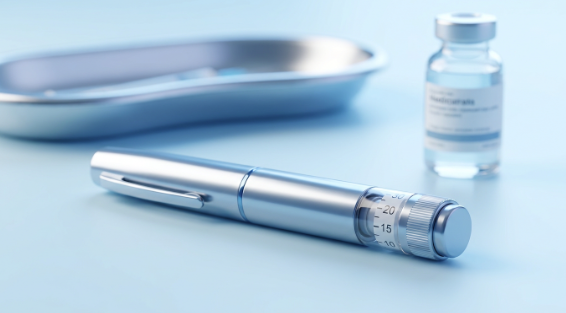
The schedule for the approved weight-management version, Saxenda, is laid out with a kind of patience I did not anticipate [1]. You do not begin at the maintenance dose. You begin at 0.6 mg once a day, and you simply stay there, doing nothing else, for a week. Then 1.2 mg for a week. Then 1.8 mg. Then 2.4 mg. Finally, if your body has tolerated each step, you arrive at the 3 mg maintenance dose, roughly five weeks after you started, moving up in 0.6 mg increments at intervals of about a week [1]. It is a once-daily injection, under the skin, from a prefilled pen.
What struck me, reading this closely, is that the slowness is not incidental caution tacked on by a risk-averse legal department. The label states plainly that the gradual climb exists to blunt the gastrointestinal side effects this whole drug class is known for, the nausea chief among them [1]. Which means the staircase and the side-effect plan are the same object. Skip a step and you are not being efficient. You are removing the one mechanism built to keep you comfortable enough to finish.
There is a second detail buried in there that I think explains a lot of the forum noise. The label allows you to pause on a step, or delay the next one, if you are not tolerating it [1]. So this is not a rigid forced march with a single correct pace. It flexes around how you actually feel, in real time, which is precisely the kind of judgment call a clinician makes and a stranger on a forum cannot, because a forum post has no idea how you feel this week.
Two passports, one traveler
Here is a confusion I watched trip people up over and over, and it is worth untangling because it sends people chasing the wrong number entirely. Liraglutide travels under two different names, and each name carries a different ceiling.
For weight management, it is Saxenda, and the maintenance dose is 3 mg a day [1]. For type 2 diabetes, the identical molecule is sold as Victoza, dosed lower, up to 1.8 mg a day. So when one person in a thread says their maintenance dose is 1.8 mg and another insists on 3 mg, nobody is lying and nobody is wrong. They are simply carrying different passports for different trips. I watched people argue about this as though it were a contradiction to be resolved. It isn’t. It’s two approved uses sharing one molecule, and the first question worth asking about any dosing claim online is which passport the person is actually holding, because most threads never say.
What the climb is actually buying you
A dose only means something once you attach it to an outcome, so I went to the trials.
In SCALE Obesity and Prediabetes, the main weight trial, adults with overweight or obesity but without diabetes who reached the 3 mg dose lost about 7.9 percent of body weight at 56 weeks, against about 2.6 percent on placebo. Roughly 63 percent of them lost at least 5 percent of their weight, versus about 27 percent on placebo [3]. In people with type 2 diabetes, SCALE Diabetes found about 6 percent loss on 3 mg against about 2 percent on placebo [4]. So the climb has a real payoff, measured in large controlled trials, not a hypothetical one.
And if you’re wondering why the label stops at 3 mg rather than pushing further, given that a bigger number sounds like it should do more: 3 mg is simply the dose that was studied and approved for this use [1]. It’s the tested ceiling, not a suggestion. The place people tend to get hurt is rarely the approved staircase. It’s the freelancing past the top step, into territory nobody actually measured.
The mountain question the milligrams can’t answer
Then I ran into a piece of evidence that genuinely rearranged how I think about the whole conversation. There’s a head-to-head trial, STEP 8, that pitted once-daily liraglutide at 3 mg directly against once-weekly semaglutide at 2.4 mg. Liraglutide produced about 6.4 percent average weight loss. Semaglutide produced about 15.8 percent [6].
Sit with that gap for a second, because it reframes everything upstream of it. People in those forums were agonizing over whether to hold at 1.8 mg an extra week, or shave a few days off the climb to 2.4 mg, fine-tuning their pace on a staircase that, even climbed perfectly, tops out well below what a different staircase offers. The most consequential dosing decision was never about pace. It was about which mountain you’re on. That’s not a question a milligram thread can answer for you, because it isn’t a dosing question at all. It’s a clinical one, and it’s exactly the kind of thing a prescriber is supposed to raise before you take your first step.
Why the climb needs a guide
By the end of all this reading, I didn’t come away with a magic number. I came away with the sense that this particular dose is precisely the part of the process you shouldn’t be running solo out of an unlabeled vial, and the label itself makes that case louder than I expected. The schedule has to be climbed gradually. It sometimes has to pause, based on how a specific body responds. It has a studied ceiling you’re not meant to exceed. And it sits inside real warnings, including a boxed warning about thyroid C-cell tumors observed in rodents, plus a contraindication for anyone with a personal or family history of medullary thyroid carcinoma or MEN 2 syndrome [1]. None of that is a self-serve situation. In the adolescent trial, gastrointestinal side effects showed up meaningfully more often on liraglutide than placebo, which is the escalation story reappearing in actual young bodies [7].
This is where supervision earns its keep, because a dose here isn’t a fact, it’s a process that unfolds over weeks. With a provider such as FormBlends, a licensed clinician makes the actual prescribing decision and manages the climb as a real clinical relationship rather than a guess. The FormBlends tracker app gives you a place to log your dose, your weight, and how you’re feeling between visits, so whoever is guiding your ascent is working from an actual record instead of your fuzzy recollection at the next appointment. That’s the unglamorous scaffolding the forums simply don’t have. A stranger online can’t adjust your next step when the 1.8 mg stage leaves you nauseated for three days straight. A clinician holding your actual data can.
Quick answers, since the dose is what brought you here
What is the weight-management dose? A daily injection climbed from 0.6 mg upward in 0.6 mg steps at roughly weekly intervals, to a 3 mg maintenance dose, per the Saxenda label [1].
Why does it take so long? Because the slow climb is specifically there to limit gastrointestinal side effects, and you’re allowed to pause or delay a step if your body isn’t ready for it [1].
Is 3 mg the same as the diabetes dose? No. The diabetes product, Victoza, caps out at 1.8 mg. The 3 mg figure belongs to Saxenda, the weight-management product. These two get mixed up constantly.
Should I just climb faster to the top? That’s the exact move the label is designed to prevent, and it’s a clinician’s call to make with you, not a forum’s to make for you. The schedule is the side-effect plan, not paperwork for its own sake [1].
Does a higher liraglutide dose close the gap with newer drugs? No. Even climbed perfectly to its full 3 mg ceiling, liraglutide trailed semaglutide badly in a head-to-head trial, roughly 6.4 percent against 15.8 percent [6]. The ceiling is the ceiling, and no amount of careful titration raises it.
What is liraglutide, actually, and what’s it used for?
It’s a synthetic version of a hormone your gut naturally releases after you eat, approved to treat type 2 diabetes and, at a higher dose, chronic weight management. The two FDA-approved brand names are Victoza for diabetes and Saxenda for obesity. Some doctors use it off-label for related metabolic conditions too, though that use carries less standardized dosing guidance.
Is liraglutide just Ozempic under another name?
No, they’re related but distinct. Both are GLP-1 receptor agonists working through a similar mechanism, but semaglutide (Ozempic, Wegovy) has a longer half-life, so it’s a once-weekly injection where liraglutide is daily. Trial data also suggests semaglutide tends to produce greater average weight loss, though individual responses vary and the two haven’t been compared across large long-term head-to-head studies beyond STEP 8.
Is the weight-loss use actually approved, or is that off-label?
Saxenda, liraglutide at 3 mg daily, is specifically FDA-approved for chronic weight management in adults with a BMI of 30 or higher, or 27 and above with at least one weight-related condition. At the right dose and brand, it’s fully on-label. The 1.8 mg Victoza formulation is approved for diabetes only, so using it purely for weight loss would step outside its approval.
Where people go wrong chasing this outside a prescription
Research-chemical sites sell unlabeled peptide vials marketed as liraglutide, and there’s no way to verify purity, concentration, or sterility from a label alone. Compounding pharmacies operating under physician supervision, like FormBlends, are an entirely different category, because a licensed prescriber reviews your case and the pharmacy answers to state and federal oversight. The dosing math in the forums often looks precise. It usually starts from a baseline nobody actually verified.
References
[1] U.S. Food and Drug Administration. Saxenda (liraglutide) injection, prescribing information. https://www.accessdata.fda.gov/drugsatfda_docs/label/2020/206321s011lbl.pdf
[3] Pi-Sunyer X, Astrup A, Fujioka K, et al. A Randomized, Controlled Trial of 3.0 mg of Liraglutide in Weight Management (SCALE Obesity and Prediabetes). New England Journal of Medicine. 2015;373(1):11-22. https://www.nejm.org/doi/full/10.1056/NEJMoa1411892
[4] Davies MJ, Bergenstal R, Bode B, et al. Efficacy of Liraglutide for Weight Loss Among Patients With Type 2 Diabetes: The SCALE Diabetes Randomized Clinical Trial. JAMA. 2015;314(7):687-699.
[6] Rubino DM, Greenway FL, Khalid U, et al. Effect of Weekly Subcutaneous Semaglutide vs Daily Liraglutide on Body Weight in Adults With Overweight or Obesity Without Diabetes: The STEP 8 Randomized Clinical Trial. JAMA. 2022;327(2):138-150.
[7] Kelly AS, Auerbach P, Barrientos-Perez M, et al. A Randomized, Controlled Trial of Liraglutide for Adolescents with Obesity. New England Journal of Medicine. 2020;382(22):2117-2128.